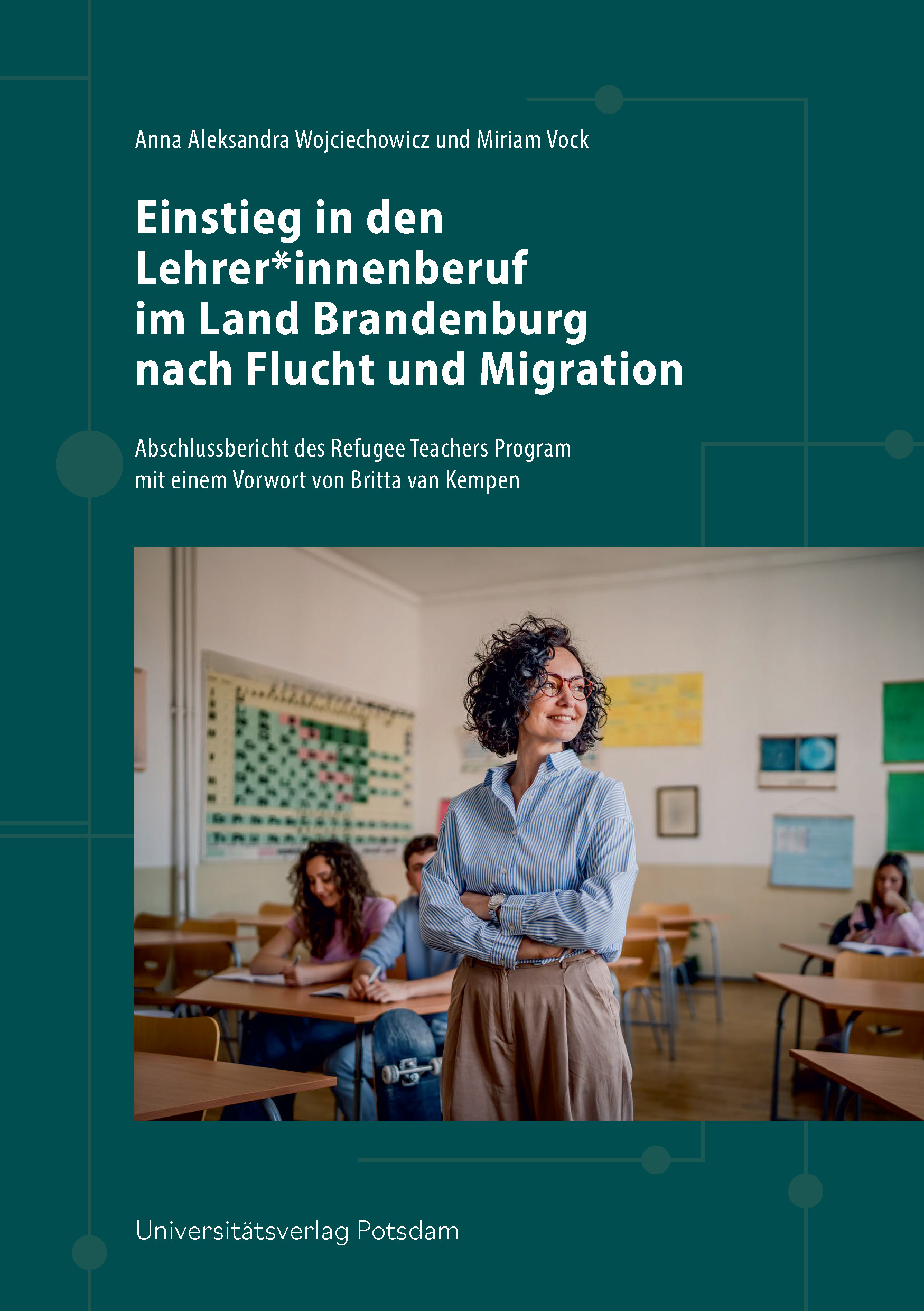

Einstieg in den Lehrer*innenberuf im Land Brandenburg nach Flucht und Migration

Abschlussbericht des Refugee Teachers Program mit einem Vorwort von Britta van Kempen


ISBN: 978-3-86956-604-7
108 pages
Release year 2026

NEU!

DOI: 10.25932/publishup-69118

With the large-scale refugee movements that began in 2015, numerous teachers trained in other countries came to Germany. However, there was hardly any opportunity for them to return to their chosen profession: recognition procedures were complex, responsibilities unclear, and specialized training and counseling services lacking. To address this need, the University of Potsdam launched the Refugee Teachers Program in 2016 with the support of the Brandenburg Ministry of Science. The aim was to enable experienced teachers with international professional backgrounds to (re)enter the teaching profession while also helping to secure skilled workers in the education sector.

The Refugee Teachers Program was the first structured qualification and counseling program for this target group in Germany. It was aimed at teachers with at least two years of professional experience and a teaching degree recognized in their country of origin. The participants came mainly from Syria, Ukraine, and Turkey and had fled war and persecution. A total of 133 participants successfully completed the demanding program. Its structure combined intensive German language training (up to level C1) with academic, didactic, and educational studies, supplemented by pronunciation training, digital literacy, job application training, and practical school placements.

Over the course of the nine-year project, the Refugee Teachers Program was continuously further expanded and refined. Starting in 2020, a paid school internship and postgraduate studies in a second teaching subject were added to facilitate full recognition of teaching qualifications. At the same time, a university counselling office for internationally trained teachers was established in 2019, which supported around 280 teachers seeking advice each year and developed into a central hub in Brandenburg. The result was a support model unique in Germany that systematically combined qualification and individual counselling.

The scientific monitoring also showed that the Refugee Teachers Program significantly strengthened the participants’ language and subject-specific skills and made it much easier for them to enter teaching or other pedagogical positions. 91% of participants achieved the target language level of C1. At the same time, the project revealed structural barriers – such as the need for a second teaching subject or long processing times for recognition procedures – and thus helped to identify areas in need of reform in the teacher training system.

His pioneering work gained nationwide and international visibility. The Refugee Teachers Program served as a model for similar initiatives at other universities and, in 2021, initiated the QuiL network (Qualification Programs for International Teachers), which now comprisestraining. The program thus makes an important contribution to the internationalization of schools and universities and to the further development of teacher training that actively shapes the reality of a migration society. The challenge now is to permanently integrate these successful structures into the regular teacher training system—as a contribution to a sustainable, equitable, and diverse education system in Germany. 17 universities. This network promotes professional exchange and the further development of common quality standards.

The Refugee Teachers Program has impressively demonstrated that tailored retraining, individual counseling, and institutional networking are key factors for the successful arrival and retention of international teachers in the German education system. It has revealed previously untapped potential and laid the foundation for a sustainable opening up of teacher training. The program thus makes an important contribution to the internationalization of schools and universities and to the further development of teacher training that actively shapes the reality of a migration society. The challenge now is to permanently integrate these successful structures into the regular teacher training system—as a contribution to a sustainable, equitable, and diverse education system in Germany.
With the large-scale refugee movements that began in 2015, numerous teachers trained in other countries came to Germany. However, there was hardly any opportunity for them to return to their chosen profession: recognition procedures were complex, responsibilities unclear, and specialized training and counseling services lacking. To address this need, the University of Potsdam launched the Refugee Teachers Program in 2016 with the support of the Brandenburg Ministry of Science. The aim was to enable experienced teachers with international professional backgrounds to (re)enter the teaching profession while also helping to secure skilled workers in the education sector.

The Refugee Teachers Program was the first structured qualification and counseling program for this target group in Germany. It was aimed at teachers with at least two years of professional experience and a teaching degree recognized in their country of origin. The participants came mainly from Syria, Ukraine, and Turkey and had fled war and persecution. A total of 133 participants successfully completed the demanding program. Its structure combined intensive German language training (up to level C1) with academic, didactic, and educational studies, supplemented by pronunciation training, digital literacy, job application training, and practical school placements.

Over the course of the nine-year project, the Refugee Teachers Program was continuously further expanded and refined. Starting in 2020, a paid school internship and postgraduate studies in a second teaching subject were added to facilitate full recognition of teaching qualifications. At the same time, a university counselling office for internationally trained teachers was established in 2019, which supported around 280 teachers seeking advice each year and developed into a central hub in Brandenburg. The result was a support model unique in Germany that systematically combined qualification and individual counselling.

The scientific monitoring also showed that the Refugee Teachers Program significantly strengthened the participants’ language and subject-specific skills and made it much easier for them to enter teaching or other pedagogical positions. 91% of participants achieved the target language level of C1. At the same time, the project revealed structural barriers – such as the need for a second teaching subject or long processing times for recognition procedures – and thus helped to identify areas in need of reform in the teacher training system.

His pioneering work gained nationwide and international visibility. The Refugee Teachers Program served as a model for similar initiatives at other universities and, in 2021, initiated the QuiL network (Qualification Programs for International Teachers), which now comprisestraining. The program thus makes an important contribution to the internationalization of schools and universities and to the further development of teacher training that actively shapes the reality of a migration society. The challenge now is to permanently integrate these successful structures into the regular teacher training system—as a contribution to a sustainable, equitable, and diverse education system in Germany. 17 universities. This network promotes professional exchange and the further development of common quality standards.
The Refugee Teachers Program has impressively demonstrated that tailored retraining, individual counseling, and institutional networking are key factors for the successful arrival and retention of international teachers in the German education system. It has revealed previously untapped potential and laid the foundation for a sustainable opening up of teacher training. The program thus makes an important contribution to the internationalization of schools and universities and to the further development of teacher training that actively shapes the reality of a migration society. The challenge now is to permanently integrate these successful structures into the regular teacher training system—as a contribution to a sustainable, equitable, and diverse education system in Germany.