
Municipal planning authority constitutes a cornerstone of the guarantee of local self-government under Article 28 (2), Clause 1 of the Basic Law (Grundgesetz). Concurrently, it operates within the multi-level system of spatial planning, which is shaped by reciprocal constraints and normative steering mechanisms. This constellation – comprising spatial planning (Raumordnung), sectoral planning (Fachplanung), and municipal land-use planning (Bauleitplanung) – is characterized by a tension between local autonomy and supra-local direction.
The thesis addresses the fundamental question of the extent to which this complex planning system still leaves sufficient scope for municipalities to steer urban development on their own responsibility. In addition to setting out the constitutional foundations – the guarantee of local self-government and municipal planning authority – and the architecture of the spatial planning system, it analyses the legal status of municipalities within that framework.
It becomes apparent that, in their current design, spatial planning control instruments threaten to relativize the weight of municipal planning authority not only in practice but also structurally. In particular, the binding effects of supra-local and sectoral plans, the arrangement of participatory rights, and legal (judicial) protection options available to the municipalities are examined in detail, and options for further development are identified with a view to strengthening – at a structural level – municipal responsibility for shaping planning and enhancing their weight within the spatial planning constellation.
The thesis argues for a systematic further development of the municipal legal status within the planning framework. Among other measures, it proposes stronger, earlier, and more binding involvement of municipalities at the level of regional planning; general procedural safeguards that translate municipal participation into substantive co-determination; and a constitutionally grounded recalibration of the doctrinal preconditions for municipal judicial protection. Beyond constitutional and legal considerations, it adopts a holistic, system-oriented planning approach that reconciles the functioning of the overall system with the preservation of municipal planning authority.
Die kommunale Planungshoheit im System der Raumplanung
ISBN: 978-3-86956-598-9
225 pages, Paperback
Release year 2025
Series: KWI Schriften , 16
License: Creative-Commons-Lizenz CC BY 4.0
19,00 €
Non-taxable transaction according to § 1 (1) UStG/VAT Act in combination with § 2 (3) UStG/VAT Act a. F. Providing this service, the University of Potsdam does not constitute a Betrieb gewerblicher Art/Commercial Institution according to § 1 (1) No. 6 or § 4 KStG/Corporate Tax Act. If the legal characterization of our business is changed to a commercial institution subsequently, we reserve the right to invoice VAT additionally. zzgl. Versandkosten
Municipal planning authority constitutes a cornerstone of the guarantee of local self-government under Article 28 (2), Clause 1 of the Basic Law (Grundgesetz). Concurrently, it operates within the multi-level system of spatial planning, which is shaped by reciprocal constraints and normative steering mechanisms. This constellation – comprising spatial planning (Raumordnung), sectoral planning (Fachplanung), and municipal land-use planning (Bauleitplanung) – is characterized by a tension between local autonomy and supra-local direction.
The thesis addresses the fundamental question of the extent to which this complex planning system still leaves sufficient scope for municipalities to steer urban development on their own responsibility. In addition to setting out the constitutional foundations – the guarantee of local self-government and municipal planning authority – and the architecture of the spatial planning system, it analyses the legal status of municipalities within that framework.
It becomes apparent that, in their current design, spatial planning control instruments threaten to relativize the weight of municipal planning authority not only in practice but also structurally. In particular, the binding effects of supra-local and sectoral plans, the arrangement of participatory rights, and legal (judicial) protection options available to the municipalities are examined in detail, and options for further development are identified with a view to strengthening – at a structural level – municipal responsibility for shaping planning and enhancing their weight within the spatial planning constellation.
The thesis argues for a systematic further development of the municipal legal status within the planning framework. Among other measures, it proposes stronger, earlier, and more binding involvement of municipalities at the level of regional planning; general procedural safeguards that translate municipal participation into substantive co-determination; and a constitutionally grounded recalibration of the doctrinal preconditions for municipal judicial protection. Beyond constitutional and legal considerations, it adopts a holistic, system-oriented planning approach that reconciles the functioning of the overall system with the preservation of municipal planning authority.
-
 2008
2008Von Alaska bis Feuerland?
5,00 €Non-taxable transaction according to § 1 (1) UStG/VAT Act in combination with § 2 (3) UStG/VAT Act a. F. Providing this service, the University of Potsdam does not constitute a Betrieb gewerblicher Art/Commercial Institution according to § 1 (1) No. 6 or § 4 KStG/Corporate Tax Act. If the legal characterization of our business is changed to a commercial institution subsequently, we reserve the right to invoice VAT additionally.
zzgl. Versandkosten
-
 2023
2023Grenzüberschreitende Daseinsvorsorge im deutsch-polnischen Grenzraum
Non-taxable transaction according to § 1 (1) UStG/VAT Act in combination with § 2 (3) UStG/VAT Act a. F. Providing this service, the University of Potsdam does not constitute a Betrieb gewerblicher Art/Commercial Institution according to § 1 (1) No. 6 or § 4 KStG/Corporate Tax Act. If the legal characterization of our business is changed to a commercial institution subsequently, we reserve the right to invoice VAT additionally.
-
 2025
2025Modellkommune Digitales Migrationsmanagement
Non-taxable transaction according to § 1 (1) UStG/VAT Act in combination with § 2 (3) UStG/VAT Act a. F. Providing this service, the University of Potsdam does not constitute a Betrieb gewerblicher Art/Commercial Institution according to § 1 (1) No. 6 or § 4 KStG/Corporate Tax Act. If the legal characterization of our business is changed to a commercial institution subsequently, we reserve the right to invoice VAT additionally.
-
 2019
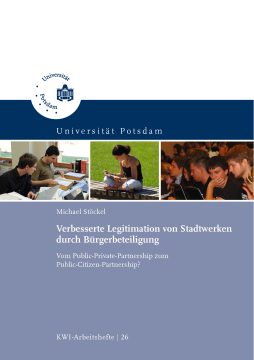
2019Verbesserte Legitimation von Stadtwerken durch Bürgerbeteiligung
8,50 €Non-taxable transaction according to § 1 (1) UStG/VAT Act in combination with § 2 (3) UStG/VAT Act a. F. Providing this service, the University of Potsdam does not constitute a Betrieb gewerblicher Art/Commercial Institution according to § 1 (1) No. 6 or § 4 KStG/Corporate Tax Act. If the legal characterization of our business is changed to a commercial institution subsequently, we reserve the right to invoice VAT additionally.
zzgl. Versandkosten